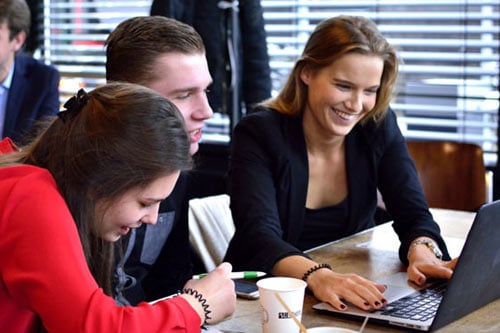
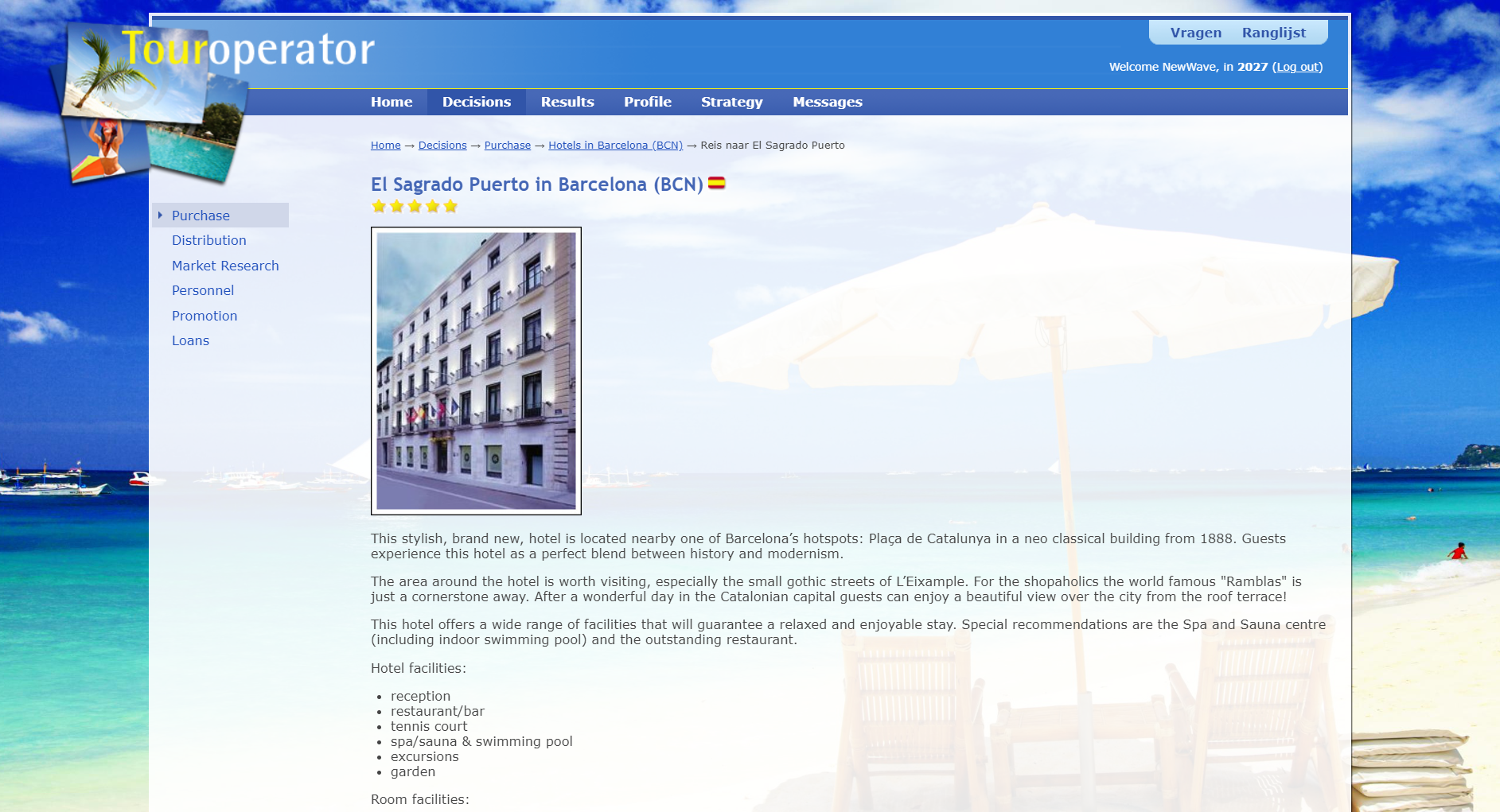
In the TourOperator business simulation, students work in teams to manage their own online travel and tourism company. Acting as the management team, they decide which destinations to offer, which customer segments to target, the service levels they wish to provide, the hotel allotment agreements they negotiate, and the prices they charge.
Across multiple decision rounds, students analyse market data, evaluate the performance of their destination and hotel portfolio, and adapt their strategy in response to changing market conditions. Their objective is to improve overall business performance, increase market share, and outperform competing teams by achieving the highest score on the simulation's Balanced Scorecard, which measures both financial and strategic success.
The TourOperator business simulation is played over a number of decision rounds, with each round representing one year of business operations.
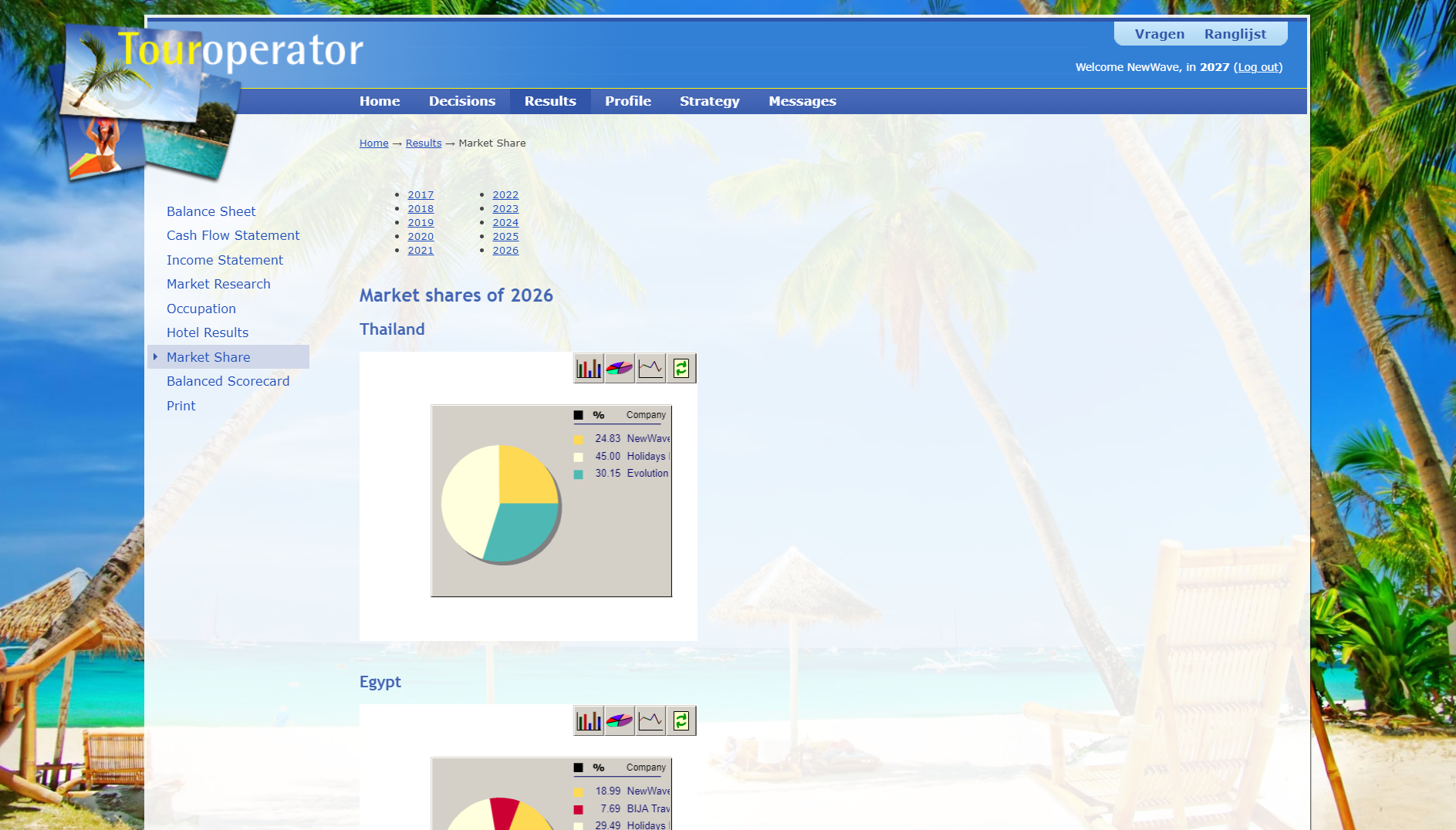
At the start of each round, student teams conduct a comprehensive internal and external analysis. They review key performance indicators such as market share (relative to competing student teams), customer segment performance, financial results, local representative performance, industry news and events, and their overall Balanced Scorecard results.
Based on this analysis, teams define or refine their strategic direction and translate this into a series of tactical decisions. They negotiate allotment agreements with hotel chains across a range of international destinations, determine package prices, select service levels, manage local representatives, and decide which excursions and value-added services to offer their customers.
Throughout the simulation, teams must continuously balance profitability, customer satisfaction, market positioning and long-term strategic objectives. Their goal is to outperform competing tour operators and achieve the highest overall score on the Balanced Scorecard.
"Student feedback has been really good. The module received a 90% student satisfaction rate. I’ve never had any negative feedback for the Tourism Management module, and I think the simulation is one of the main reasons for that.”
| Suitability | |
|---|---|
| Student Levels: | UG, PG |
| Module subjects: | Tourism Management, Hospitality and Events Management |
| Languages: | |

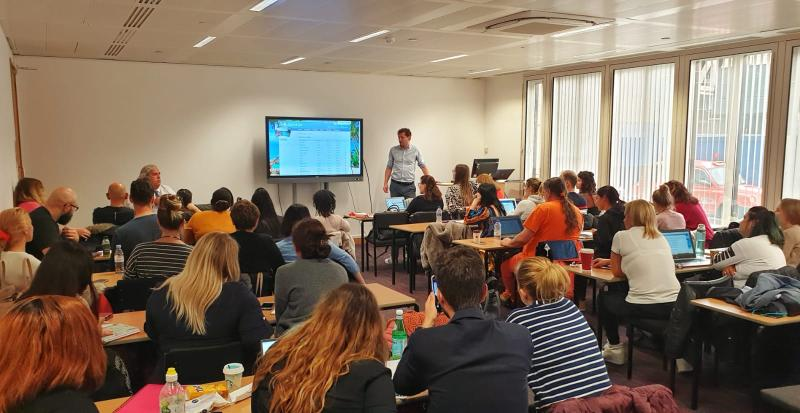
In a business simulation, theoretical models are put into practice. They provide participants with a unique experience in which mutual collaboration, analytical thinking and insight into complex and dynamic relationships result in the acquisition of key learning skills and objectives.
Register for exclusive offers, industry and new product updates, as well as our tips for great e-learning experiences for your students.
.png?length=300&name=unnamed%20(11).png)
.png?length=300&name=unnamed%20(7).png)
.png?length=300&name=unnamed%20(8).png)
.png?length=300&name=unnamed%20(6).png)

.png?length=300&name=unnamed%20(10).png)
.png?length=300&name=unnamed%20(5).png)
.png?length=300&name=unnamed%20(9).png)
.png?length=300&name=unnamed%20(4).png)
.png?length=300&name=unnamed%20(2).png)
.png?length=300&name=unnamed%20(1).png)
.png?length=300&name=unnamed%20(3).png)
.jpg?length=300&name=unnamed%20(2).jpg)





.png?length=300&name=loughborough-university-logo%20(small).png)



Management simulation
Edubook
application recieved
We have received your question and we will return to you within 24 hours on workdays.